
Custom Lead Fields
Lead fields are the things you want to know about a lead beyond the company and contact every referral already carries. Define a field once, then use it wherever you need it: ask it on your referral form, fill it in on the lead as a deal progresses, or write rules against the answers.
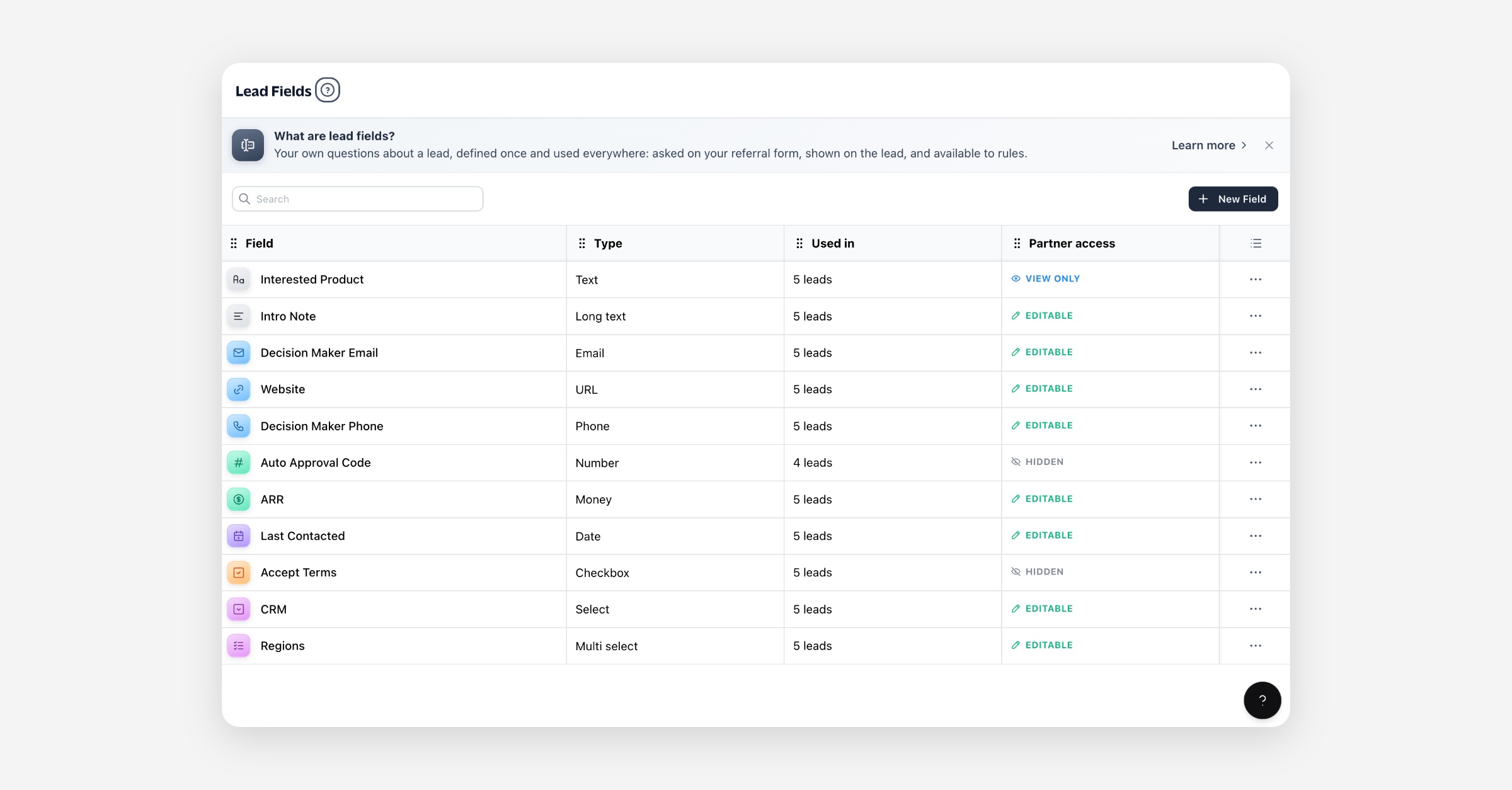
You'll find them under Leads → Lead Fields.
Before you start
Nothing is required first. You can define fields before a single lead has been referred — they'll be ready the moment one arrives.
A field is a definition, not a question on a particular form. Creating one and asking it are separate steps, which is what lets the same field appear on your referral form and on every lead without being defined twice.
The details every referral already carries — Company Name, Contact Name, Contact Last Name, Contact Email and Contact Phone — are built into your referral form rather than fields you define, so they aren't in this library. See Lead referral form.
Creating a field
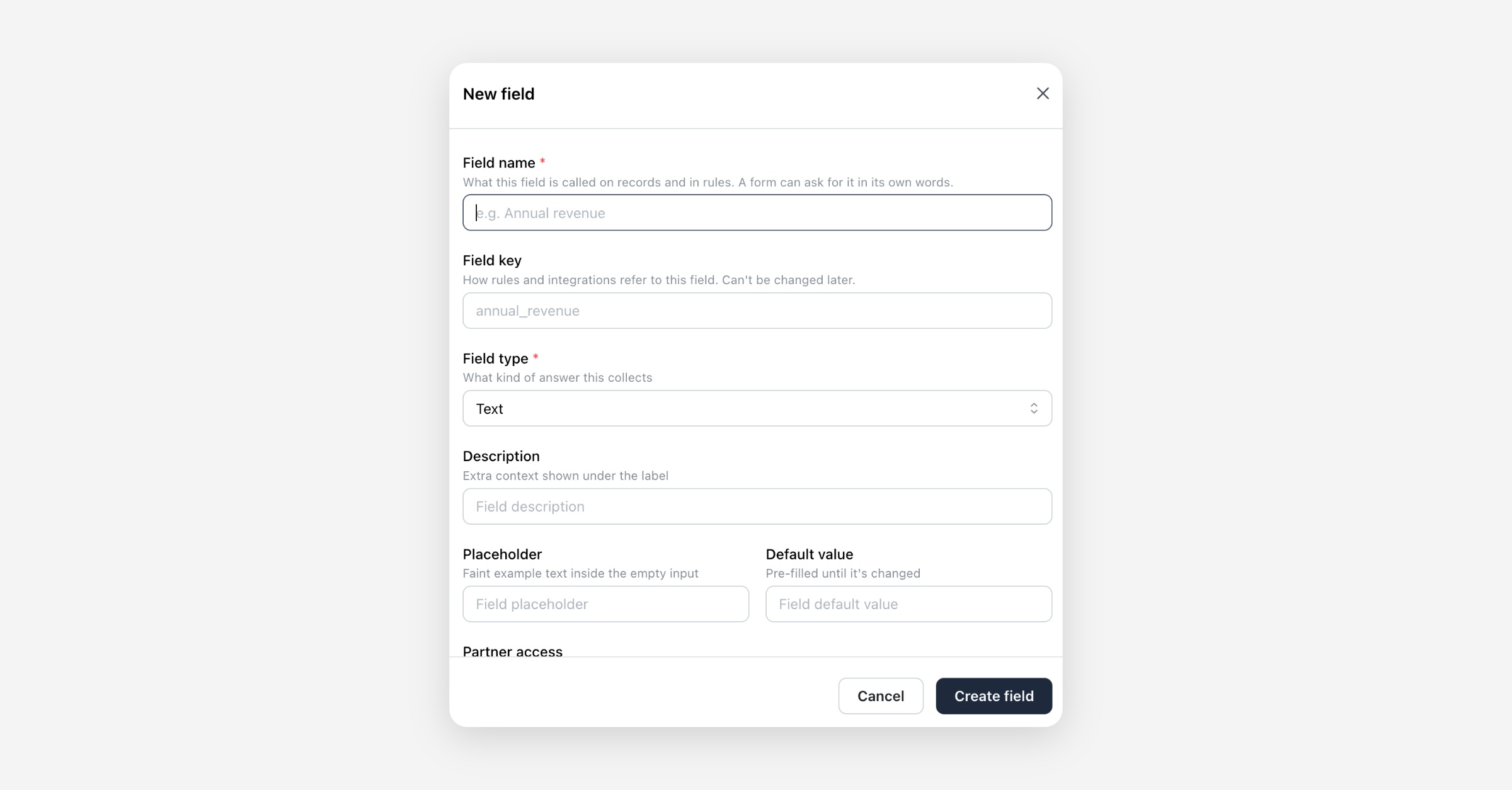
Select New Field.
Give it a field name — what the field is called everywhere in your account.
Set the field key if you want something other than the one suggested. This is how rules and integrations refer to the field.
Choose a field type — what kind of answer it collects.
For a Select or Multi select, add the choices.
Optionally add a description, a placeholder, and a default value.
Set Partner access — what partners can do with the field on leads they referred.
Select Create field.
Field names must be unique within your account, and a field key must start with a letter and use only lowercase letters, numbers and underscores.
Field types
Type | What it collects |
|---|---|
Text | Short free text. |
Long text | Multi-line free text. |
An email address, checked as it's typed. | |
URL | A web address. |
Phone | A phone number. |
Number | A plain number. |
Money | An amount, in your program's currency. |
Date | A calendar date. |
Checkbox | A single yes or no. |
Select | One choice from a list you define. |
Multi select | Several choices from a list you define. |
Every type can be asked on your referral form, Number, Money and Date included.
A Select or Multi select keeps answers to a fixed list, which makes them easier to write rules against later than free text.
A money question is asked in your program's currency, whoever is answering, so amounts are comparable and a rule compares like with like.
A checkbox has no empty box to hint at, so it takes no placeholder. A default value is offered only where a default reads as text — Text, Long text, Email, URL, Phone and Number.
What you can and can't change later
Name | Change any time. It updates everywhere the field appears. |
Description, placeholder, default value | Change any time. |
Partner access | Change any time. |
Choices | Add, rename and reorder any time. A choice already recorded against a lead can't be removed — you'll be told which one is in use. Renaming keeps existing answers. |
Field key | Fixed. Rules and saved answers point at it. |
Field type | Fixed. Answers are stored by type. To change a type, create a new field and delete the old one. |
Partner access
Every field carries one setting for what partners may do with it on leads they referred.
Setting | What the partner sees |
|---|---|
Hidden | Nothing. The field is for your team only. |
View only | The field and its answer, with no way to change it. |
Editable | The field and its answer, which they can update. |
Partner access affects what partners see on a lead, and nothing else. A hidden field is still a normal field to you: it shows on the lead for your team, and rules can read it.
It doesn't reach your referral form. A field you put on the referral form is asked of everyone referring a lead, whatever its access — hidden fields included. Partner access governs the record, not the intake. Set a field to Hidden and it will still be asked if it's on the form; the referring partner just won't see the answer on the lead afterwards.
Where answers come from
Your referral form. Put a field on your Lead Referral Form and whoever refers a lead answers it — on your referral page, in quick refer, in an embedded Register & Refer widget, and on an event form. See Lead referral form.
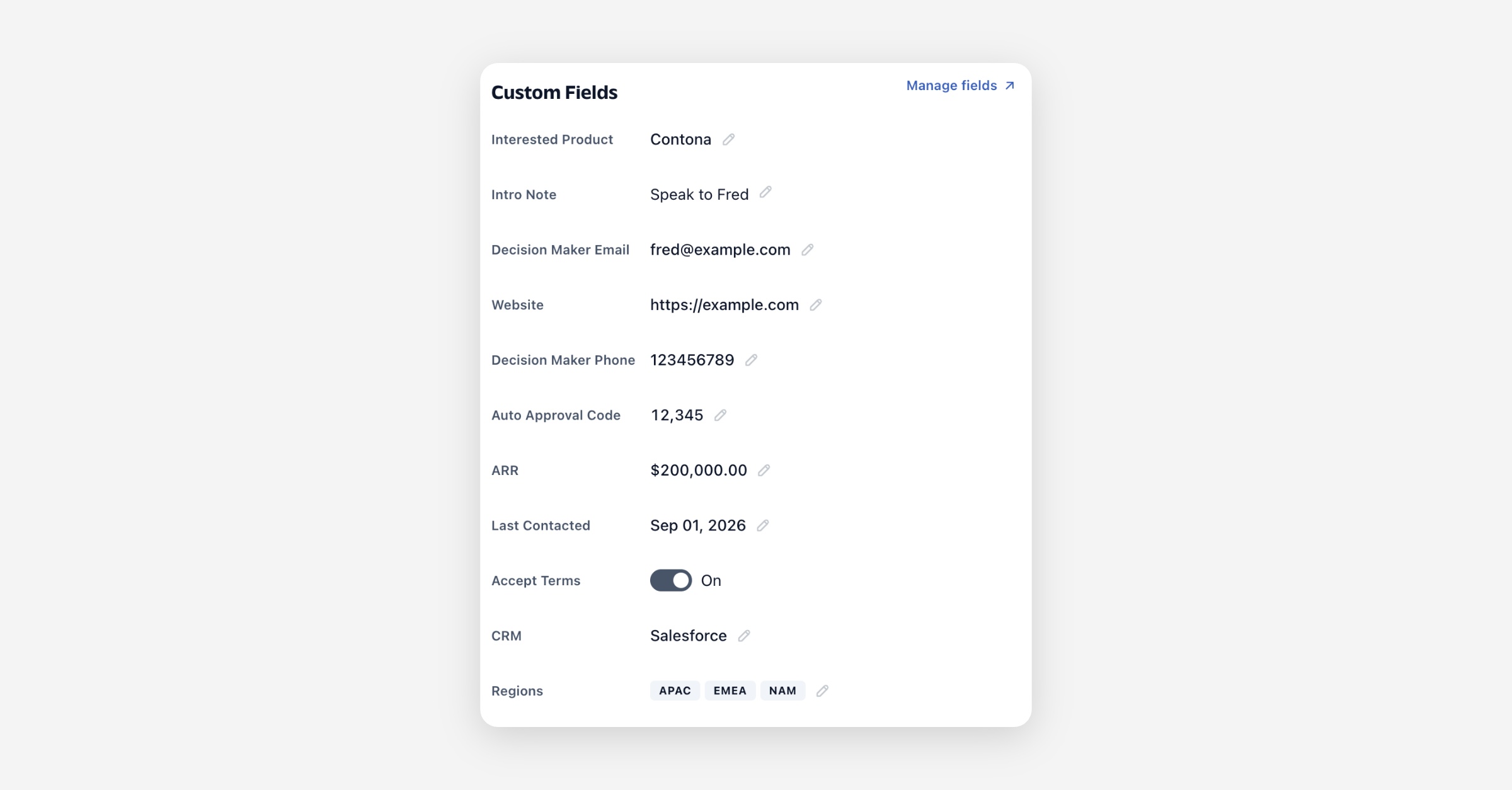
The lead itself. Every field appears on every lead whether or not it's on a form, so your team can fill in or correct an answer at any time, including from the Slack lead command.
The referring partner, if the field is set to Editable.
Your CRM. A field mapped to a CRM property picks up that property's value when the lead syncs back from your CRM. See Syncing to your CRM below.
The API. Answers can be sent in when a lead is created or updated through the API.
Managing your fields
Edit — select any field in the list.
Duplicate — copies a field's settings into a new one, so a near-identical field doesn't have to be built twice. Its CRM mapping is not copied.
Delete — see below.
Search — filter the list by name or field key.
The list shows each field's type, its partner access, and how many leads hold an answer to it.
There's no ordering here. The order questions are asked in belongs to the form asking them, and you set it in the Lead referral form composer.
Deleting a field
Deleting tells you what it would affect before it goes ahead.
A rule that references the field blocks the deletion. You're shown which rules use it and asked to change or remove them first. No retry succeeds until you do.
Answers are counted — you're told how many leads will lose their answer, and asked to confirm.
The field is removed from every form and record it appears on. If it's on your referral form, the form stops asking for it. Its CRM mapping goes with it.
A field nothing depends on is deleted straight away, with no dialog.
Deleting is permanent — the answers go with the field. If you only want to stop asking for something, remove that question from your referral form instead and the field and its answers stay.
Rules
Answers are available as conditions wherever you build rules, so a rule can read what a referral told you. This is what makes a lead field worth more than a note: Lead auto approval can approve a referral on what the partner answered, and rewards and other rules can read the same answers later in a deal's life.
A rule reads the current answer whoever provided it, so the same rule matches an answer a partner gave on your referral form, one your team filled in on the lead, and one that arrived from your CRM.
Rules point at the field itself rather than its name, so renaming a field never breaks a saved rule.
Note that a brand-new referral only holds answers to the questions your form actually asked. A field you keep internal is still offered as a condition, but a fresh referral has no value for it yet.
Syncing to your CRM
If you've connected a CRM (HubSpot, Salesforce or Pipedrive), you can map a lead field to a property in it so answers flow through automatically.
Mappings live with the integration, not with the field: go to Integrations → your CRM → Settings and find CRM Field Mapping.
Create the custom property in your CRM first. It appears as a mapping option in Partner.io once it exists, and its type should match the Partner.io field's.
Pick the Lead Fields or Deal Fields tab, depending on which side of your CRM you want the answers on. You can map the same field on both.
Select Add Field Mapping, choose the Partner.io field, and choose the CRM field.
For a Select or Multi select, match each of your choices to the equivalent option in your CRM. A mapping with choices left unmatched can't be saved.
Save.
Each CRM field can back only one Partner.io field per direction — map the same CRM field twice on the same tab and you'll be told before you can save.
Built-in lead details — Partner, Rep, Partner Type, Referred At and the rest — are mapped in the same place, in the same list.
Limits
A name, description, placeholder, choice label and choice value are each up to 255 characters.
A field key is unique within your account, per record type.
Choice values must be distinct within a field.
FAQ
Is a lead field the same as a lead attribute? No. Attributes are labels you apply to leads to segment and filter them. A lead field records an answer — a value per lead, of a type you choose, that a partner can give you when they refer.
Can I reuse a field on my partner application form? No. A field belongs to one record type. Partner questions are managed separately under Partner fields.
Where do I mark a field as required? On the form, not on the field. Requiredness belongs to the asking, so the same field can be required on your referral form and optional for your team on the lead. Open the question in the referral form composer and turn Required on.
If I remove a question from my referral form, do I lose the answers? No. Removing a question stops the form asking it. The field and every answer already given stay on the leads that hold them.
If I rename a field, do existing answers change? No. Answers and rules point at the field, not its name, so renaming is safe at any time. A form can also word the question differently without renaming the field.
Does a default value force an answer? No. A default pre-fills the box so the person referring sees a suggestion. They can clear it and submit nothing.
Do I need a CRM to use lead fields? No. Fields work on their own. CRM sync is optional.
Do answers show up in my lead export? Yes. Every lead field is a column in the leads CSV export, including ones no form asks for.
Why can't I edit the field behind a built-in question on my referral form? Built-in questions — Company Name, Contact Name, Contact Last Name, Contact Email and Contact Phone — are defined by Partner.io because creating a lead and its contact depends on them. They aren't lead fields and have no entry here.
A worked example
You want to know roughly how big each referred deal is, and you want to approve small ones automatically.
Under Leads → Lead Fields, select New Field.
Name it "Estimated deal size" and choose Money.
Set Partner access to View only so the referring partner can see the figure on the lead without changing it after the fact, then create the field.
Go to Leads → Referral Form and add "Estimated deal size" as a question. Word it "Roughly how much is this deal worth?" if that reads better on the form, and turn Required on.
Select Auto Approval on the same page and add a condition on Estimated deal size.
Partners now give you a figure as they refer, small deals approve themselves, and everything else waits for your team.
Was this helpful?