
Lead Referral Form
The lead referral form is what a partner fills in to refer a lead to you. You choose which questions it asks, in what order, and how each one is worded.
You'll find it under Leads → Referral Form.
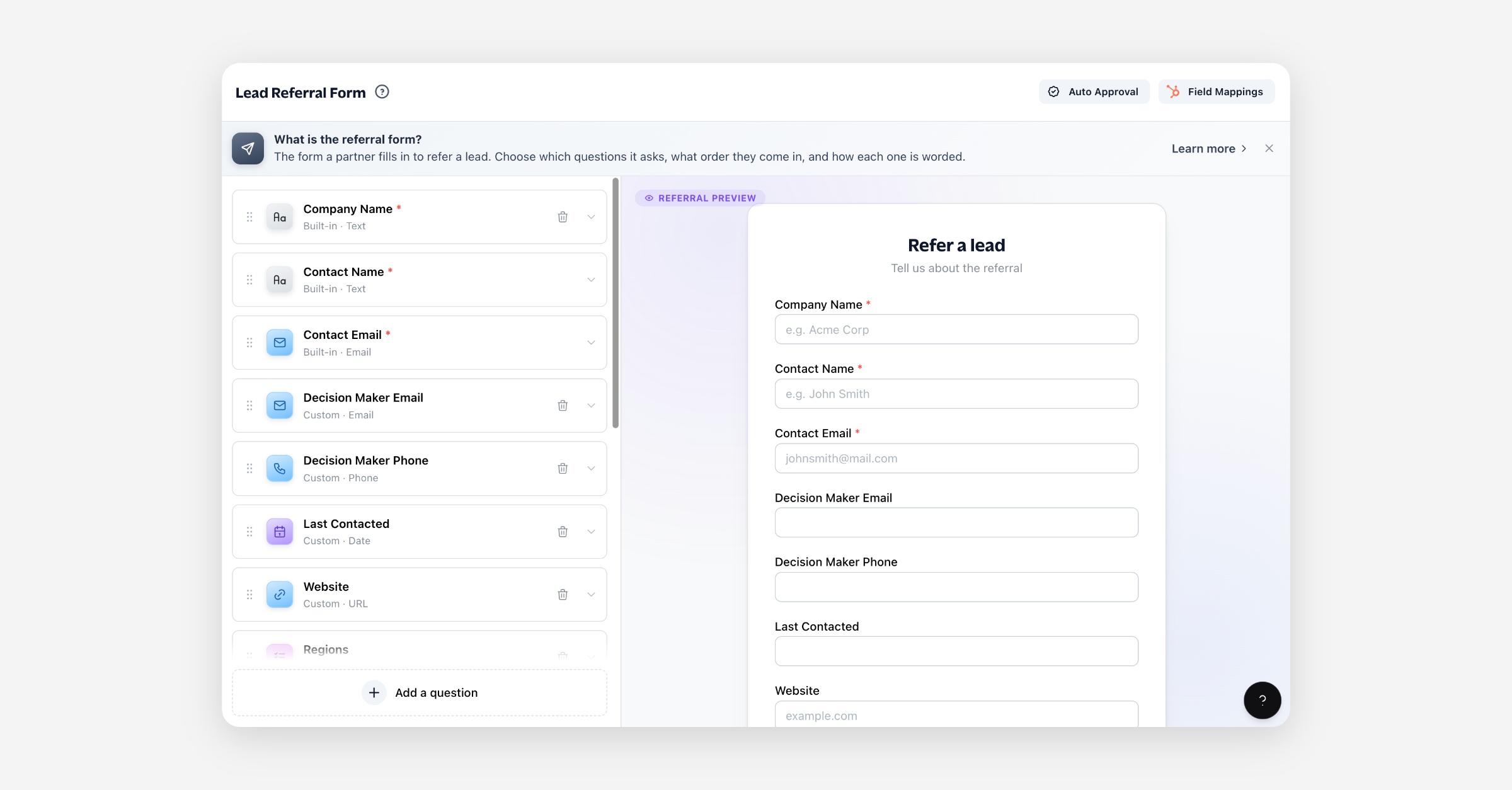
Where it appears
Each partner rep's own referral page.
Quick refer, the short referral page a partner shares from their profile.
Refer a lead inside the partner portal, where a signed-in rep refers without leaving it.
The referral half of the Register & Refer widget you've embedded on your own site. See Register & Refer widget.
All four read the same form, so a change here reaches every place a lead can be referred. There is no save step in the composer: each change commits on its own and is live immediately.
Your own team is not covered by it. Adding or editing a lead from inside Partner.io offers every lead field you've defined, whatever this form was composed to ask.
Before you start
Nothing is required first. Every program has a referral form from the day it's created, already asking for the details a lead can't be built without.
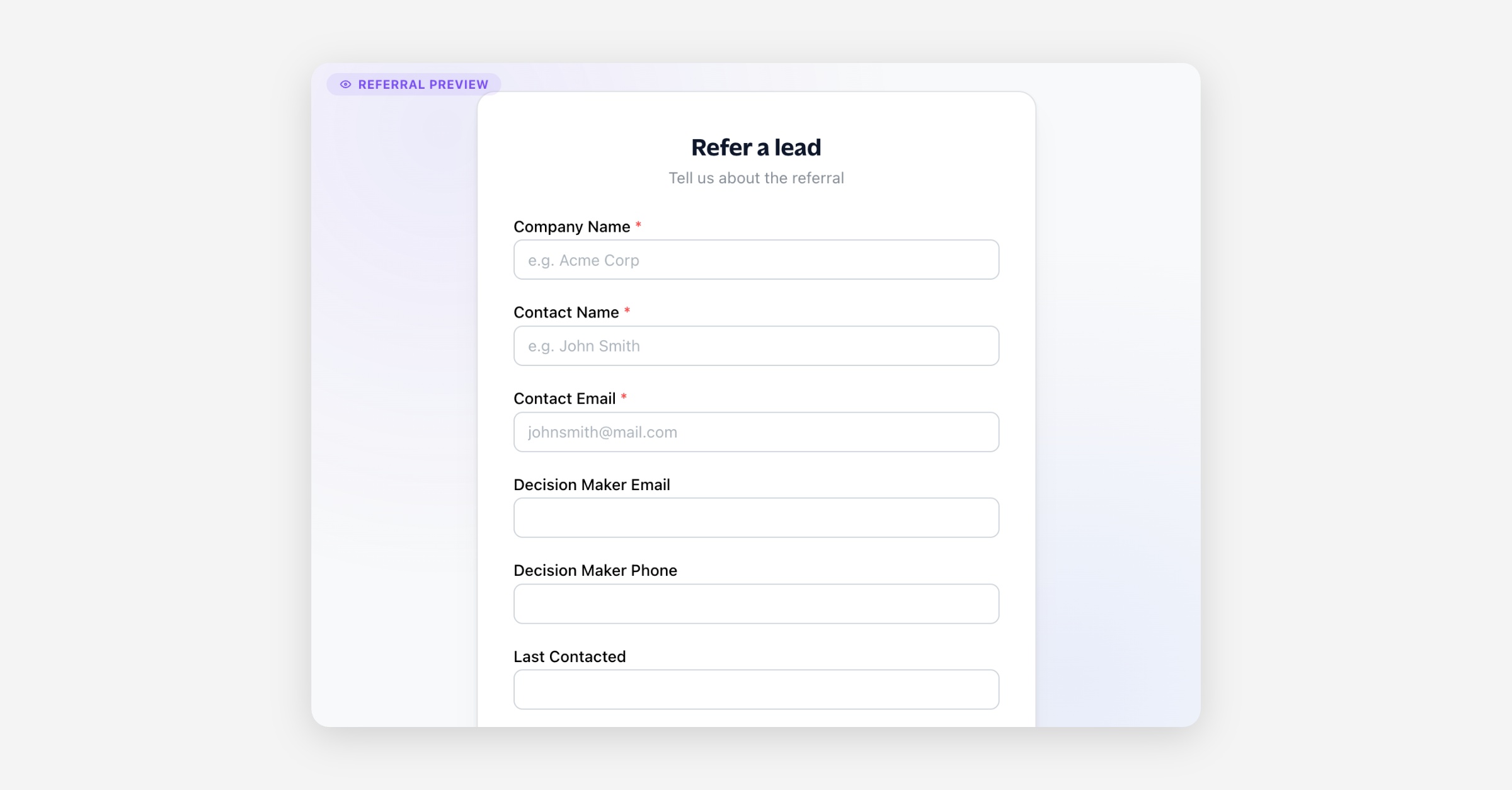
The two kinds of question
Built-in fields
The details Partner.io needs to create the lead and its contact, so the platform defines what they are and what they collect. Where each answer goes varies: Contact Name and Contact Email build the contact, and Company Name names the lead itself.
Field | On the form |
|---|---|
Contact Name | Always |
Contact Email | Always |
Company Name | Optional, asked by default |
Contact Phone | Optional, asked by default |
Contact Last Name | Optional, not asked by default |
Shopify Store | Optional, not asked by default; offered once Shopify is connected |
Contact Name and Contact Email can't be removed: without them there's no lead to create. The other three are yours to add or remove whenever you like.
Two of them change what a submission produces:
Company Name is what the lead is called. Leave it off and the lead is named from the contact's email domain instead, and only from a business one — a personal address falls back to the contact's own name.
Contact Last Name splits the name across two boxes. Add it and the contact is asked for both halves, which are stored as one name. Keep it next to Contact Name in the order, or the person referring meets the two halves of one name in different parts of the form.
One is only offered once your account can use it:
Shopify Store asks for the lead's
myshopify.comdomain and records it on the lead, where Shopify install matching reads it. It appears in the add list once a Shopify integration is connected. The answer has to be a myshopify domain —yourstore.myshopify.com, with or without thehttps://— and is stored in that form whatever was pasted. If you add it and later disconnect Shopify, the question stays on the form until you remove it.
Built-in questions start at the top of a new form, but nothing pins them there — drag any of them wherever you like.
Your own fields
Anything else you want to ask. Add a lead field you've already created, or create a new one without leaving the form. Answers are saved against the lead, show on the lead's record, and can be used in rules.
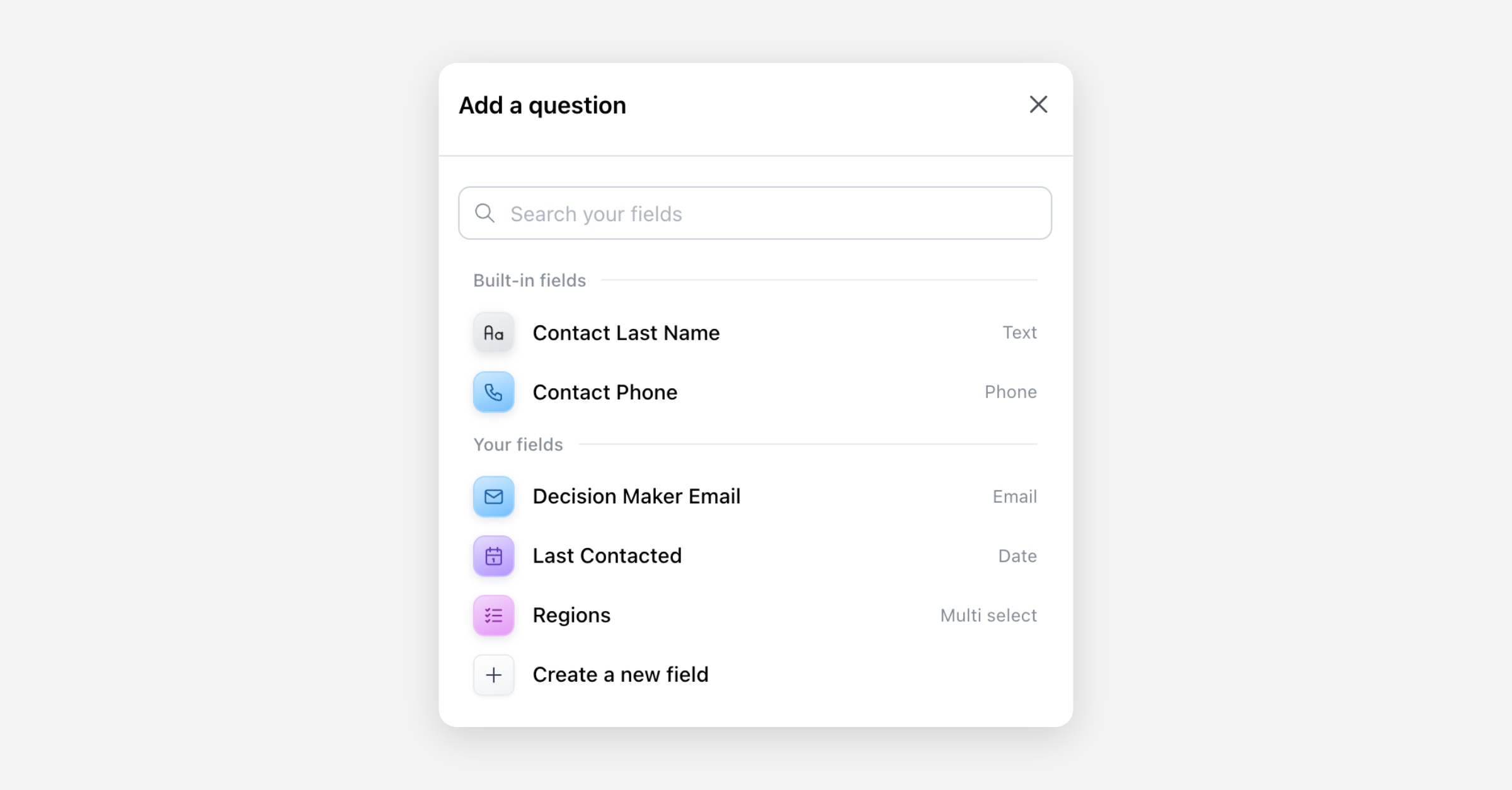
How to
Add a question
Select Add a question.
Search, then pick a field — or select Create a new field to make one on the spot. Whatever you typed in the search box becomes its starting name.
It's added to the end of the form, not required.
Creating a field and adding it to the form are two separate steps, so a field you create stays in your field library whether or not it ends up on this form. Your lead fields themselves are managed under Leads → Lead Fields, covered in Lead fields.
A field you've already added no longer appears in the picker, since a field can be on the form only once.
Reorder
Drag a question by its handle. Questions are answered top to bottom, and the preview follows as you drag.
Open a question
Select a question to open its settings. Everything about it lives there: whether it's required, how this form words it, and — for one of your own fields — the field its answers are saved to.
A question marked required carries a red asterisk in the list, the same mark the person referring sees.
Mark a question required
Open the question and turn Required on.
For Contact Name and Contact Email the switch is locked on, since a lead can't be created without them.
Requiredness is a property of the question, not of the field. The same field can be required here and left blank on a lead record your team fills in.
Every question you require is one more thing to fill in before a referral can be sent, and a blank required question stops the submission. Require only what you genuinely need.
Reword a question
Open a question and edit any of:
Question — what the person referring reads above the field.
Placeholder — the greyed-out hint inside the empty field. Not offered for a checkbox, which has no empty box to hint at.
Help text — extra guidance beneath the field.
Leave a box empty to use the default wording; the default shows greyed out inside it. Clear a box at any time to hand the wording back to the default.
Wording applies to this form only. The field keeps its name everywhere else: your field library, the lead's record, and any rules that reference it. Answers already collected are unaffected.
This is also how you translate your form. If your partners read Polish, word every question in Polish; nothing else in your account changes.
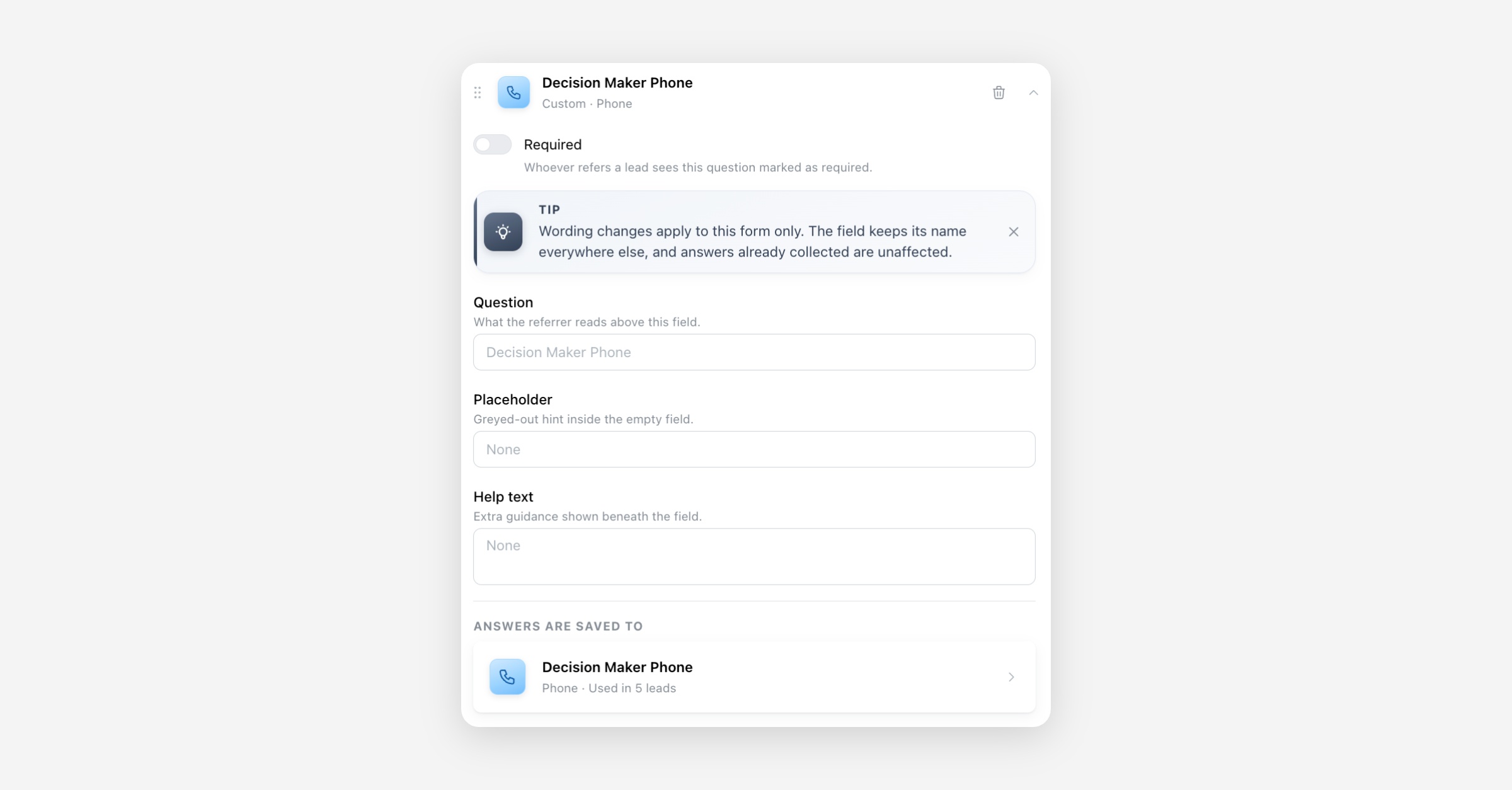
Edit the field behind a question
For one of your own fields, the bottom of an open question shows the field its answers are saved to, along with how many records already hold an answer. Select it to open that field's own settings, where you change its name, its options, and what partners can see. Changes there apply everywhere the field appears, not just on this form.
Built-in questions have no such card. Their answers go wherever creating the lead needs them rather than into a single field, and Partner.io defines them, so there's nothing to open.
Remove a question
Select the remove icon on the question. You'll be asked to confirm.
Removing a question stops it being asked. Answers already collected are kept, and if it was one of your own fields, the field stays in your library — only this form stops asking for it.
Contact Name and Contact Email have no remove icon.
Field reference
A question shows the type of answer it accepts. Every field type can be asked here, including Number, Money and Date.
Type | What it collects |
|---|---|
Text | Short free text. |
Long text | Multi-line free text. |
An email address, checked as it's typed. | |
URL | A web address. |
Phone | A phone number. |
Number | A plain number. |
Money | An amount, in your program's currency. |
Date | A calendar date. |
Checkbox | A single yes or no. |
Select | One choice from a list you define. |
Multi select | Several choices from a list you define. |
The type belongs to the field, not to this form, and can't be changed after the field is created — saved answers are stored by type.
Partner access
Every lead field carries a Partner access setting — Hidden, View only or Editable — for what partners can do with that field on leads they referred.
It has no bearing on this form. Referring a lead is you asking the question, so every question on the form is asked of everyone referring, hidden fields included. Partner access starts applying to the answer afterwards, on the lead record.
Permissions
Managing the referral form is an admin surface. Partners never see it — they see only the form itself.
Limits
A field can appear on the form only once.
A question, placeholder or help text is up to 255 characters.
FAQ
Does a required question actually stop a referral? Yes. A blank required question is flagged and the referral isn't submitted until it's answered.
If I reword a built-in question, does it still collect the same thing? Yes. Wording is separate from what a question collects. Retitle "Company Name" as something else and answers still become the lead's name — so keep the two aligned, or your leads will hold something other than what they claim. A reworded built-in says which one it is beneath the question, so you can see at a glance when the two have drifted.
Can I ask different questions on the referral page and in the widget? No. There is one referral form, and every surface asks it. What differs between surfaces is only their own framing — the heading, the styling, the button — not the questions.
Can I reuse a partner field here? No. A field belongs to one record type. Questions on this form come from your lead fields, covered in Lead fields; partner questions are managed separately under Partner fields.
What happens to answers if I delete a field entirely? Deleting a field is done from your field library, not here, and it tells you what the deletion would affect before it goes ahead. Rules referencing the field block the deletion outright.
Where do I set up auto approval for referrals? If your program has lead auto approval, Auto Approval in this page's header opens it; see Lead auto approval. Auto approval reads the answers this form collects, so a condition can only match a question the form actually asks.
A worked example
You want partners to tell you roughly how much the deal is worth, and you don't want to be asked about leads under a threshold.
Add a question → Create "Estimated deal value" as a new field.
Choose Money as the type and create it. "Estimated deal value" is now its name everywhere: your field library, lead records, and any rule you write against it. Amounts are collected in your program's currency.
It's added to the end of the form. Drag it above Contact Phone.
Open it and turn Required on, so no referral arrives without a figure.
Set the Question to "Roughly what is this deal worth?", with Help text of "Your best estimate is fine."
Every referral now carries a value you can read in a rule — including an auto approval condition that approves anything above your threshold and leaves the rest pending.
Was this helpful?